

History of Durbin Estate Project
History
What is the Durbin Project?
This project is a multi-phase project to develop a mixed-income mixed-use green affordable housing community as a statewide demonstration. It is being developed in partnership between Western Kentucky University and Habitat for Humanity, with many other state and local community partners.
The Durbin Project is located at a 14.3 acre site owned by Habitat for Humanity Bowling Green-Warren County (HFH BG-WC) and is within the Jennings Creek watershed and Bowling Green city limits. It is being designed to incorporate an integrated green infrastructure, high energy efficiency buildings, renewable energy, native plants and habitat restoration features, and sustainable agriculture practices. It will eventually comprise up to forty-three high energy performance residences, a community center, shared green space and walking trails, community gardens, and other features. Community education, school education, media outreach and professional training are integral parts of this project. The site will be used as an outdoor learning laboratory for area schools and for research projects by the University. Project results will be broadly disseminated through media, social networking, and a PBS documentary.
Funding has been acquired for Phases 1 & 2 from the Kentucky Division of Water, through Environmental Protection Agency 319(h) nonpoint source pollution funds under the Clean Water Act. Phase I will create an integrated green infrastructure using Low Impact Development (LID) techniques to manage stormwater and Phase 2 will create road, utility and associated green infrastructure to permit housing construction to begin. Goals are to enhance water quality and sustainable community development, and to promote public awareness through Best Management Practices (BMPs); professional and community education; and cooperation among agencies, citizens, and government.
Vision
The goal of this project is to demonstrate an integrated green infrastructure statewide demonstration for community development that can be broadly replicated to reduce nonpoint source pollution, educate the public, and improve quality of life for communities.
Site Plans
For on site pictures of the site before development click here.

Timeline
| Date | Event |
| 2006 | HFH BG-WC purchases 14.3 acre site for future build |
| 2007 | BGGreen Partnership for a Sustainable Community presents concept to Board |
| 2008 | Initial site plan is developed by WKU Geog-Geol class |
| 2010 | Federal 319(h) funding from #PA is awarded by Kentucky Division of Water |
| Jan 2011 | Project begins/first Advisory Coucil meeting held |
| Feb 2011 | Tour/Charrette for public participation in community design |
| Mar 2011 | Flood analysis by WKU Hydrology class |
| April 2011 | Survey and Engineering Plans by Arnold Consulting Engineering and Surveying |
| May 2011 | Roundstone Native Seed becomes partner |
| June 2011 | Best Management Practices-Implementation Plan (BMP-IP) approved |
| Sept 2011 | Open Neighborhood Meeting |
| Nov 2011 | Planned Unit Development (PUD) approved by Bowling Green City Commissioners |
| Mar 2012 | Rain Barrel Workshop for Dishman-McGinnis Families |
| Aug 2012 | $297,000 Grant Extension from the KY Division of Water |
| Aug 2012 | Vernal Pond installation |
| Aug 2012 | Green Infrastructure Implementation by Scott & Ritter, Inc. begins |
| Oct 2012 | Native pond plants planted in the vernal pond |
| Nov 2012 | Installation of 50 white pine trees as a trail border and 40 bald cypress trees in the infiltration basin |
| June 2013 | Plugs Planting Day-small settings of grass plants were planted in upland drainage channel |
| June 2013 | Native grass seeds were planted in the upland area, channel and bio-infiltration area |
| June 2013 | Underground utilities were installed for the first three houses |
| July 2013 | Gravel bed is installed for the on-street parking lane |
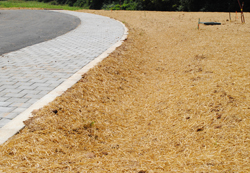
| Aug 2013 | Permeable blocks on installed for the on-street park |
| Aug 2013 | Bio-swales along on-road parking lane has been completed |
| Nov 2013 |
Three classes from Dishman McGinnis Elementary School attended the Durbin site to learn about karst environments, nonpoint source pollultion and watershed management. |


Some of the links on this page may require additional software to view.